What If Blue-Collar Learning Ended in Actual Work, just Not a Certificate?
I have been thinking about a platform for blue-collar workers that does more than teach a skill and hand out a certificate.
Most learning platforms stop at the certificate. You finish a set of videos, answer a few questions, and receive a document saying you completed the course. That may be useful in some fields, but practical work is different. A plumber, electrician, carpenter, mechanic, or construction worker becomes good through observation and repeated practice. The real test is whether they can do the work properly.
That leaves me with two questions. How do you design online learning for someone whose classroom is usually a workshop or a job site? And how do you make that learning useful when they look for work?
My idea is to connect learning, proof, and income in one place. I have not tested it with workers yet, so what follows is a concept, not a claim that I have solved the problem.
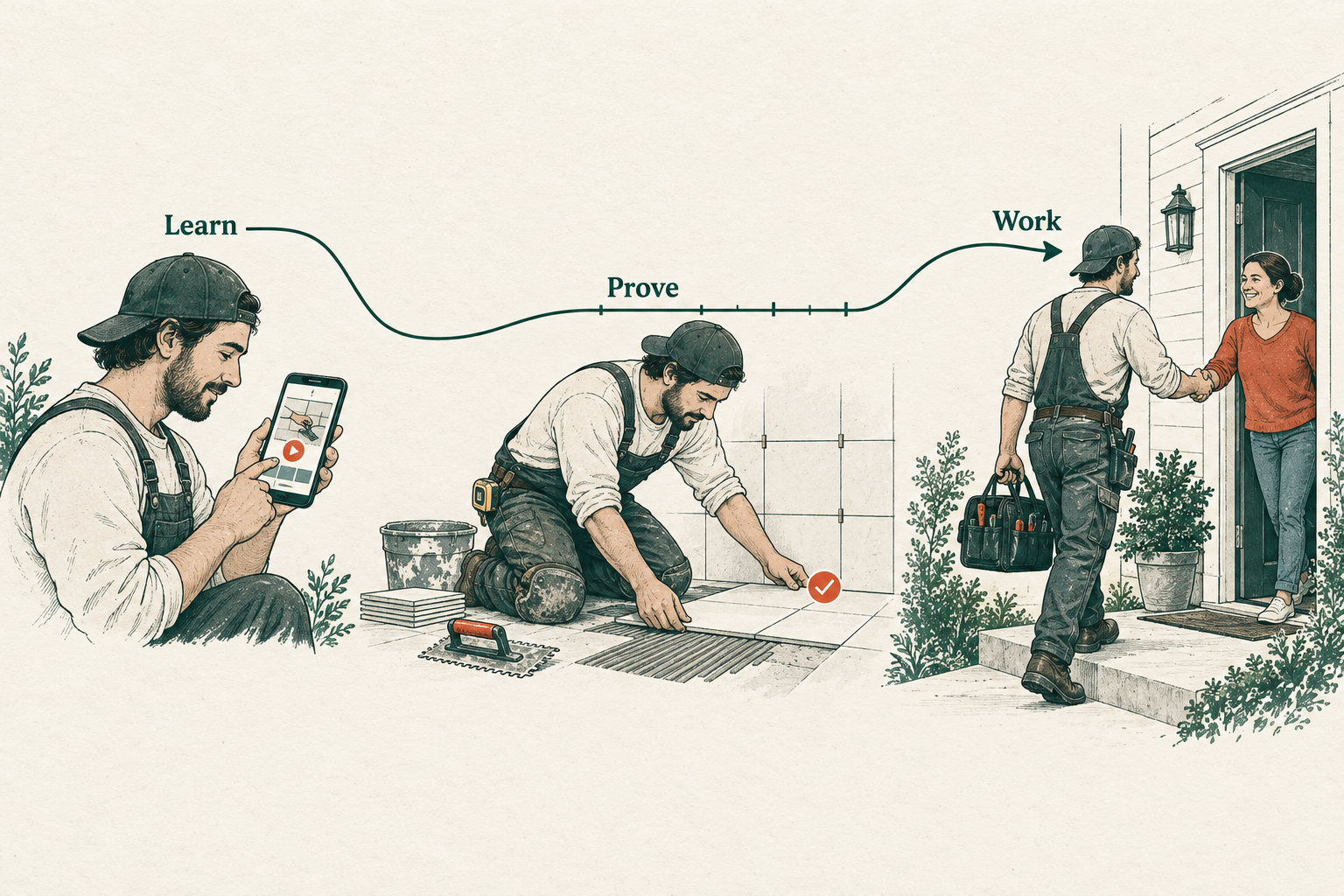
Learn. Prove. Work. The value of a course should continue after the final lesson.
Learning that fits the worker
Imagine a construction worker who wants to learn tile installation.
He opens a short module in his preferred language. Audio and diagrams explain how to prepare the surface, measure the space, align the tiles, and spot common mistakes. Small interactions ask him to identify a safety problem or put the steps in the correct order.
This matters in India and across many developing countries. The design would have to account for inexpensive phones, unreliable internet, shared devices, and people who are more comfortable with speech and visuals than long text. Translating a normal online course would not be enough. The course itself would have to work differently.
Augmented reality could help with certain tasks. A worker might point the phone camera at a wall and receive guidance on measurements or alignment. Someone repairing equipment could see the order in which parts should be checked. It could be used practical assessments
I would still treat AR as an extra. If the main experience needs a recent phone and a fast connection, it will exclude many of the people it is supposed to help. Audio, lightweight video, diagrams, and downloaded lessons should carry most of the experience.
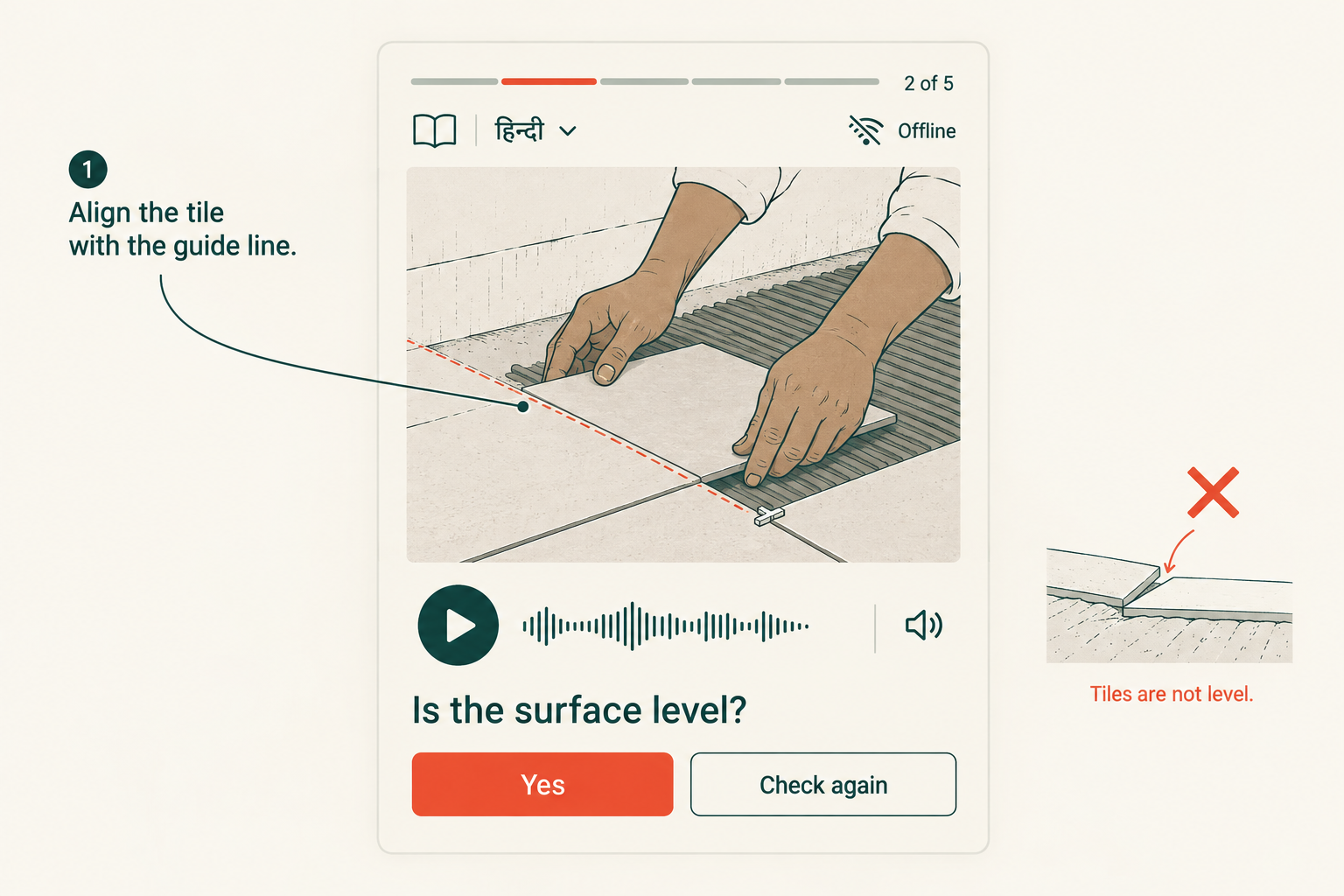
A practical lesson should make the next action clear, even on a basic device.
A badge should mean something
The next problem is proof.
Course completion only proves that a person reached the end of a course. It does not prove that they can perform the task. If the platform gives everyone a badge after a few videos, employers will stop trusting those badges very quickly.
Assessment should depend on the trade. A learner could upload photographs or a video of finished work, respond to realistic situations, complete a supervised task, or have the result checked by an experienced professional. A badge should also state exactly what was tested. Completing a lesson on electrical safety is not the same as demonstrating residential wiring skills.
These badges could form part of a portable profile with skills, languages, availability, work samples, experience, and feedback. Experienced workers should be able to take an assessment directly instead of repeating beginner lessons.
What interests me here is the possibility of making experience easier to see. A worker may know far more than a normal online profile can show. Work samples and specific assessments could provide better evidence than a broad claim such as “experienced electrician.”
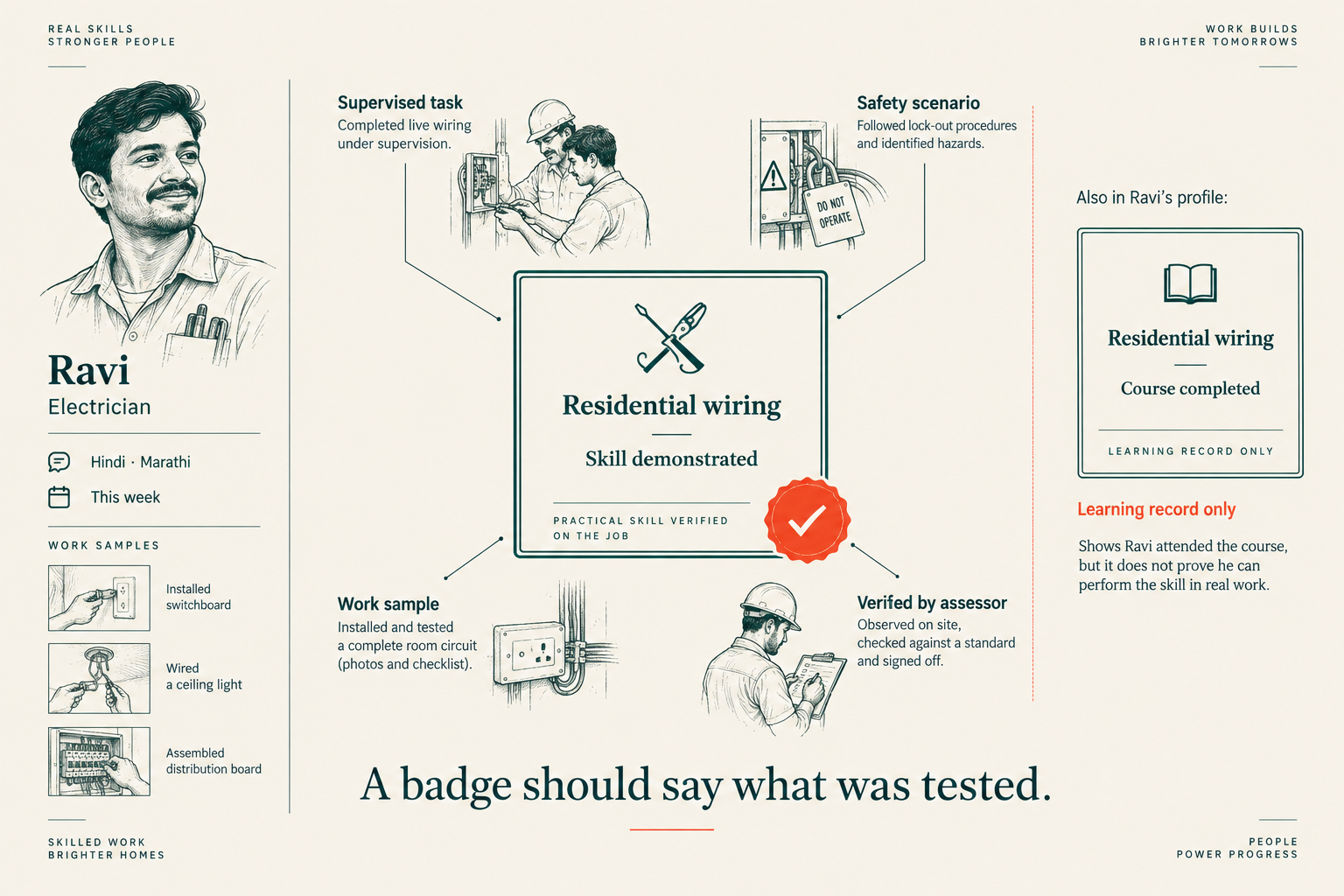
A badge becomes useful when an employer can see what was actually tested.
From learning to actual work
This is where the idea becomes more than an education platform.
After proving a skill, a worker could use the same profile to find jobs. A customer could compare skills, distance, availability, past work, and reviews.
Each completed job could add more evidence to the profile. Learning and employment would no longer have to live in separate systems. One could strengthen the other.
There is another possibility too: short, paid video consultations.
Suppose somebody's water pump stops working. Before paying for a visit, they could book a brief call with a technician. The technician looks at the problem through the camera, asks a few questions, and decides whether there is a safe, simple fix or whether an in-person repair is required.
This would not replace physical work. In the right categories, it might prevent an unnecessary trip and let experienced workers earn from what they know, not only from hours spent on site.
There would need to be clear limits. Electrical, structural, medical, and other safety-sensitive advice cannot be handled like an ordinary call. Some problems should always end with a recommendation for an in-person inspection.
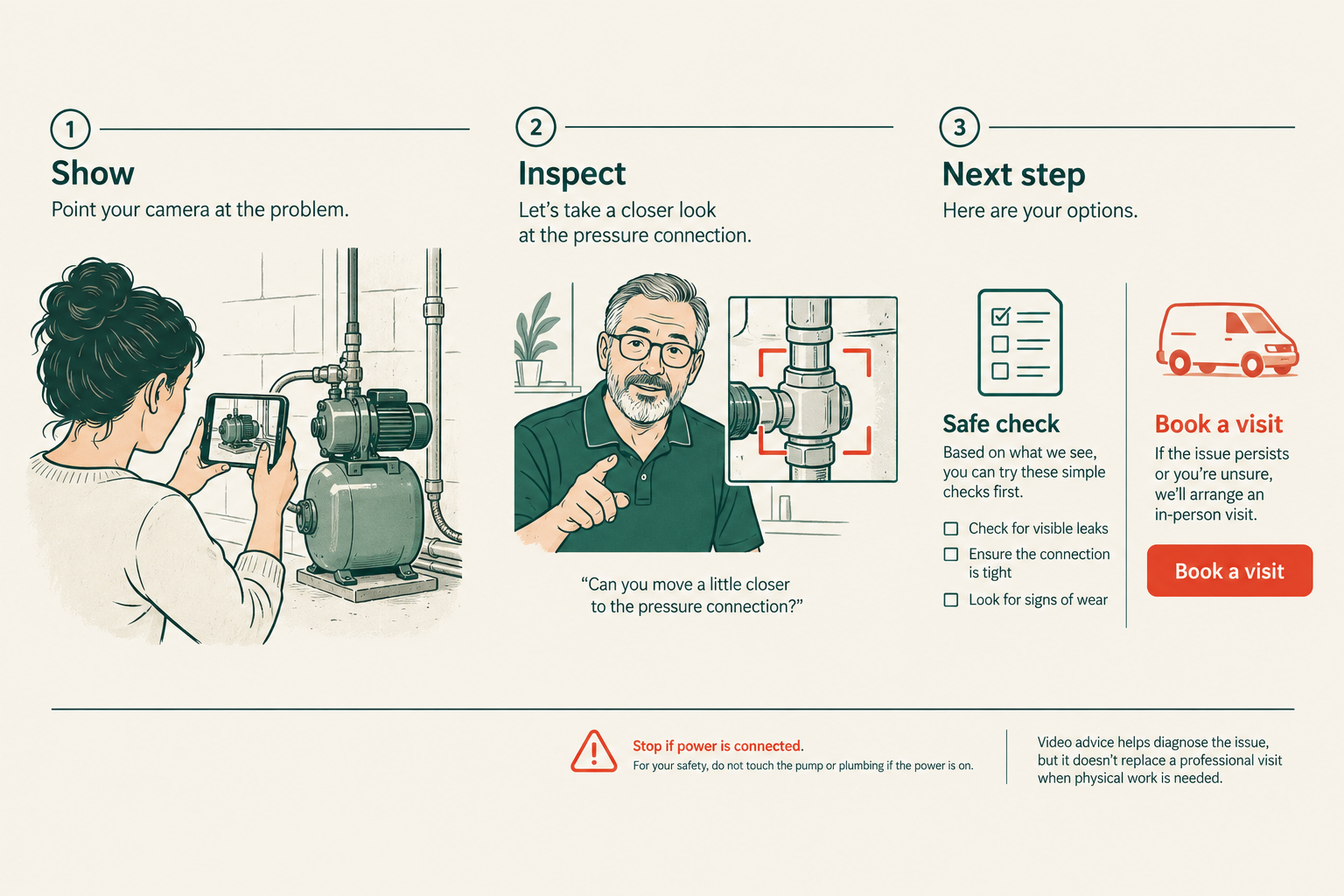
Remote advice can reduce unnecessary trips, but it should make escalation easy when physical work is needed.
Where AI may actually help
I do not think the platform needs to look like an AI product. A large chatbot on every screen would probably make it harder to use.
AI could work quietly underneath the experience. A worker could speak instead of filling out forms. It could translate lessons, read instructions aloud, organize work photos, or help match nearby jobs.
During a consultation, it could translate between the worker and customer or produce a short summary of the call. None of this needs to feel like “using AI.” It should simply make the service easier to use.
The risks are obvious. Generated instructions can be wrong, and wrong advice around tools, machinery, electricity, or construction can cause real harm. The platform would need to show when AI was involved and avoid letting it act like a qualified professional.
The difficult questions
The software may be easier to build than the trust around it.
Workers need to believe a module can improve their income. Employers need to know what a badge represents. Both sides need protection from fake profiles, dishonest reviews, unsafe work, unfair pricing, and withheld payments.
Localization is another difficult part. India alone contains many languages, trades, working methods, and local markets. The differences grow further across South Asia, Africa, Southeast Asia, and Latin America. A lesson, payment method, or trust signal that works in one place may make little sense somewhere else.
So this idea would have to begin with a narrow group of workers in one place. The first useful test would not be whether hundreds of courses can be published. It would be whether a worker can learn one valuable skill, prove it properly, and get a better opportunity because of it.
I see the idea as a bridge between education and work. It gives practical learning somewhere to lead, while giving workers a clearer way to show what they can do.
It is still only a concept, and the hardest parts are not solved. But I think the direction is worth exploring: help someone learn, help them prove it, and make that proof useful in the real world.
If you had to test this with one trade in one place, where would you begin?